Researchers from the United States in association with Germany have recently come across an astonishing discovery that could aid the treatment of tumor suppression.
Researchers at Columbia University and Memorial Sloan Kettering Cancer center discovered that the tumor suppressor protein p53 blocks the mevalonate pathway responsible for synthesis of cholesterol and isoprenoid compounds. This in turn was found to suppress tumor formation in liver cells of mice models. The findings were published in journal Cell few days ago.
The melavonate pathway is an important pathway to synthesise cholesterol and some non-sterol compounds. They found that blocking SREBP-2, an important factor that activates transcription of enzymes involved in mevalonate pathway blocks the pathway. The scientists discovered ABCA-1, a transporter gene used to block SREBP-2. If ABCA-1 was removed the tumor was found to increase in size.
SREBP-2 is a transcription factor embedded in the Endoplasmic reticulum (ER). Upon cholesterol depletion, it is transported to golgi apparatus where it is cleaved and enters the nucleus to activate mevalonate pathway.
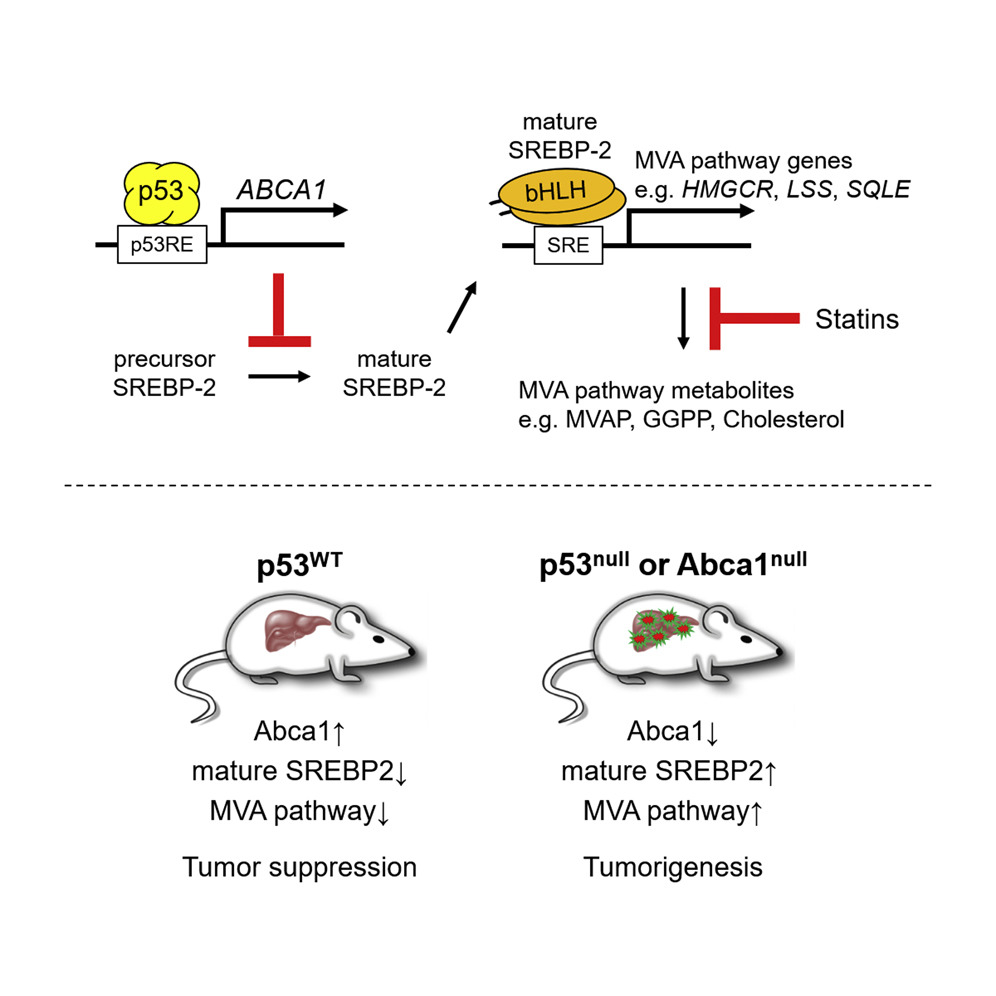
Tumor Suppression, 2019, Cell
p53 was found to increase ABCA-1 and inhibit SREBP-2. They delay SREBP-2 synthesis by transporting cholesterol to ER where it is not recognized by SREBP-2. In p53 null cells, SREBP-2 maturation occurs as cholesterol is not transported by ABCA-1, thereby activating mevalonate pathway and aiding tumorigenesis.
This research highlights the therapeutic potential of using p53 protein to inhibit mevalonate pathway and prevent liver tumors. Also, it highlights the use of p53 as a marker to predict cancer.
Article: Moon et al., p53 Represses the Mevalonate Pathway to Mediate Tumor Suppression, Cell (2019), https://doi.org/10.1016/j.cell.2018.11.011

 Microphile's musings